On this page
Overview
- Start with the product, order and peak-throughput data before comparing layout options.
- Compare storage density with selectivity, travel, handling equipment and whole-project cost.
- BIM helps review geometric interfaces; fire-code compliance needs the responsible designers and authority process.
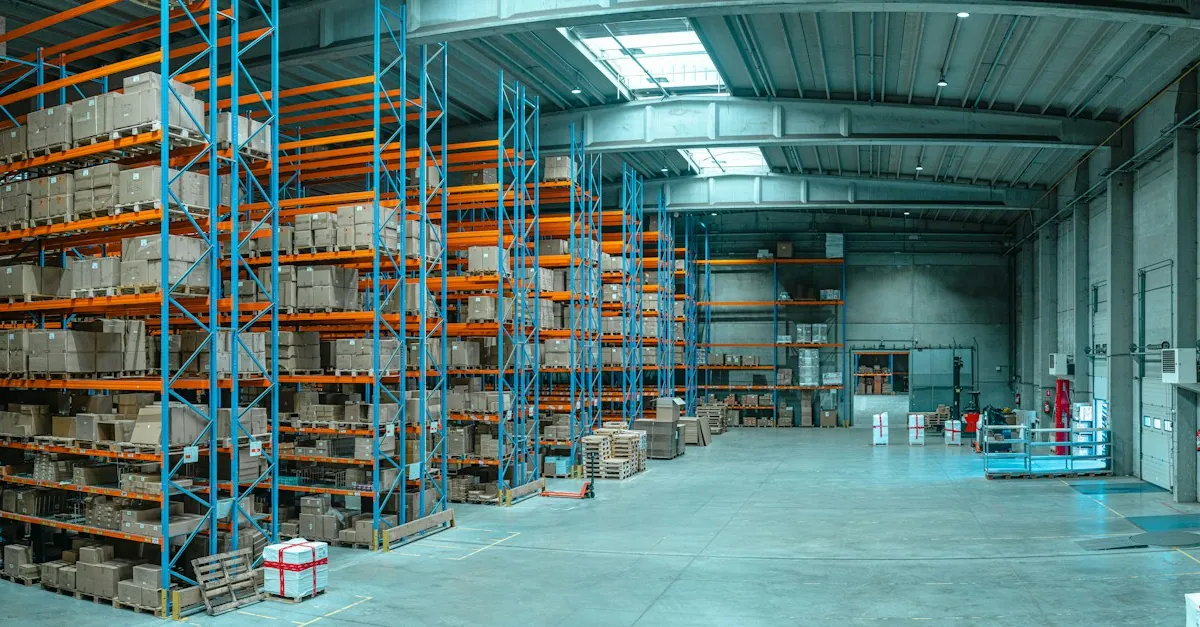
A warehouse layout starts with what comes in, how it is stored and how it leaves. Order volumes, pallet sizes and handling equipment determine the space each operation needs. The layout then has to fit those movements around racking, structure, building services and safe access routes.
Warehouse layout design inputs
Scroll sideways to compare
| Input | Why it changes the layout |
|---|---|
| SKU and order profile | Controls selectivity, storage medium, pick faces and replenishment strategy |
| Inbound and outbound throughput | Sets dock count, staging area, travel intensity and peak-hour capacity |
| Unit loads and materials-handling equipment | Controls rack geometry, aisle envelope, floor loading and clear height |
| Value-added and returns processes | Creates work cells, quarantine zones and non-storage circulation |
| Fire strategy and future growth | Controls compartments, sprinkler coordination, egress and expansion allowances |
Scroll sideways to compare
| Deliverable | What the reviewer should be able to check |
|---|---|
| Design-basis and data register | Source and date of SKU, order, peak, pallet, shift, growth, MHE, fire, utility and site assumptions |
| Flow and adjacency options | Receiving, storage, picking, value-add, returns, quarantine and dispatch relationships with stated trade-offs |
| Capacity and throughput model | Storage positions, pick faces, dock and staging demand, travel assumptions, bottlenecks and sensitivity to peak conditions |
| Racking and MHE layout | Rack type and load, aisle and turning envelopes, end clearances, protection, pedestrian routes, charging or automation interfaces |
| Coordinated building model | Structure, slab and loading, racking, fire protection, egress, lighting, utilities, maintenance access and future expansion interfaces |
| Issue and decision register | Open inputs, clashes, safety or authority questions, design owner, due date, decision and acceptance status |
Flow comes first
The layout starts from material flow. A through-flow layout (receiving one end, dispatch the other) suits high-volume linear operations; a U-flow (receiving and dispatch on the same side) shares dock resources and shortens travel for many distribution operations. The flow decision sets dock positions, aisle orientation, and where value-add areas sit.
Aisles follow the MHE operating envelope
There is no universal warehouse aisle width. It must be derived from the selected forklift or automation system, load dimensions, turning path, lift height, rack protection, pedestrian segregation, speed, visibility and the clearance required by the applicable safety rules. A narrow-aisle concept is therefore an equipment-and-operations decision, not a drafting shortcut.
Compare height with whole-project cost
Racking selection
- Selective racking gives access to every pallet. It has the lowest density and greatest flexibility, so it suits a varied product range.
- Drive-in / drive-through: high density for few SKUs, deep lanes, lower selectivity.
- Push-back and pallet-flow: dense with better rotation than drive-in.
- ASRS: assess storage density, throughput, redundancy and maintenance against the operating case. Equipment tolerances and capital costs need supplier confirmation.
Coordinating structure, racking & fire
Racks, the building frame, sprinklers and lighting must fit in the same space and meet the fire requirements. Check them together, especially in tall or automated warehouses. A sprinkler blocked by a rack or a rack that clashes with the frame can be expensive to move on site.
Regional project context changes the layout brief
Scroll sideways to compare
| Project context | Inputs to confirm | Retained responsibility |
|---|---|---|
| United States and the Americas | State, province or national jurisdiction; OSHA or local worker-safety requirements; adopted building and fire codes; rack and MHE criteria; I-P or SI units | The owner, locally appointed professionals, rack and MHE suppliers, fire-protection designer, contractor and AHJ retain their defined design, fabrication, installation and approval roles |
| Middle East | Country, emirate or municipality; employer and consultant requirements; building, fire and civil-defence interfaces; ambient heat and dust; labour, vehicle and cold-storage conditions | Dubai, Saudi and other jurisdictions have distinct requirements; appointed local parties and authorities retain statutory review and approval |
| Europe | Country-specific building, fire, workplace and equipment requirements; SI units; client logistics criteria; energy, automation and worker-interface assumptions | UK HSE or other guidance applies only in its proper jurisdiction or contractual context; the local design and authority route remains controlling |
Plan the warehouse flow
Spetia Engineering can develop and coordinate documented flow, racking, MHE, structure, fire, utility and access requirements in a shared layout model. Capacity and throughput remain dependent on the supplied operating data and assumptions; appointed designers, suppliers, contractors and authorities retain their contractual reviews and approvals.
Technical references
Sources for the definitions and design context discussed here. Check the applicable edition and project requirements before using them in design.
- 01Warehousing and storage: A guide to health and safetyUK Health and Safety Executive
- 02Safety in the storage and handling of steel and other metal stock (HSG246)UK Health and Safety Executive
- 03Warehousing: Hazards and SolutionsUS Occupational Safety and Health Administration
- 04Dubai Building CodeDubai Municipality
- 05Saudi Building CodeSaudi Building Code Center