On this page
Overview
- BIM outsourcing can add production capacity, coordination expertise or design capability. State which responsibility you need before comparing partners.
- Rates are not comparable until the quote defines discipline, seniority, LOD, software, QA, management, utilisation, location, taxes, and excluded work.
- Compare fixed-scope work, hourly support and dedicated capacity against the shape of your pipeline.
- Check the information requirements, review process, access controls and decision windows before work begins.
- Test a small, paid package before committing a major project. Review the work, communication and compliance with your standards.
Do you need modeling capacity or engineering design?
These are different appointments. A production package converts defined design information into models and drawings. A design package also requires engineering decisions: developing process schemes, sizing equipment, calculating loads, evaluating options or resolving system interfaces. Ask who owns the calculations, who checks the design and who has authority to approve it. Spetia brings process and multidisciplinary design knowledge alongside BIM delivery; the proposal should state exactly which responsibilities are included.
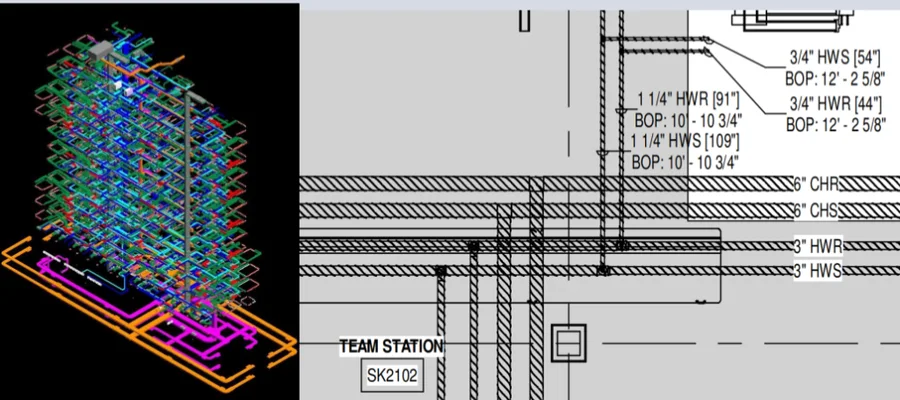
The BIM project guide explains which inputs, deliverables and review steps to agree. You do not need a completed brief to start a conversation. For design work, also agree the design basis, project standards and operating cases. A model screenshot alone does not show whether the engineering has been checked.
BIM outsourcing gives your team extra modeling, coordination or design capacity. You still retain the responsibilities in your client contract. This guide explains the different working models, how to compare quotes and what to check before choosing a partner.
What is included in BIM outsourcing
An external team can provide defined modeling, coordination, documentation or design support. Your contract should distinguish those roles and identify retained responsibilities. Agree the templates, approved working environment and review process before sharing project information.
- Architecture, structure and MEP modeling to defined element requirements. LOD 500 describes field-observed conditions, not an extra production-detail level.
- Federated coordination with issue ownership and agreed test rules.
- Scan-to-BIM with a documented survey basis and verification scope.
- Construction documentation with the required professional review and approvals.
- 4D planning and model-based quantities where the project defines their use.
- Plant and industrial design or modeling, with the design responsibilities explicitly stated.
What BIM outsourcing costs in 2026
Rates vary by country, currency, discipline, LOD, seniority, utilisation, software, management, QA, tax, and contractual risk. The useful comparison is not one hourly rate against another: compare the fully loaded internal scenario with a partner quote that states inclusions, exclusions, capacity, review responsibility, and change control.
Scroll sideways to compare
| Resource | Define in the quote | Compare against |
|---|---|---|
| BIM modeller (production) | Discipline, LOD, outputs, software, utilisation | Loaded internal production capacity |
| Senior modeller / discipline lead | Seniority, review duty, decision authority | Equivalent internal role and management |
| BIM coordinator (multi-discipline) | Coordination cycle, meetings, issue ownership | Internal coordination and rework cost |
| Dedicated capacity | Named roles, availability, QA, leave cover, change terms | Salary, benefits, tools, training, idle time |
The three engagement models, compared
Scroll sideways to compare
| Model | Best for | Watch out for |
|---|---|---|
| Fixed-scope project | Well-defined deliverables: a Scan-to-BIM conversion, a permit set, a clash report | Scope creep disputes if the brief is vague; slower change handling |
| Hourly / bucket of hours | Ad-hoc overflow, redlines, small recurring tasks | Costs drift if nobody tracks burn; quality varies with whoever is free |
| Dedicated team (retainer) | Continuous production volume; firms treating the partner as an extension of staff | Needs enough pipeline to keep the team utilized; onboarding investment up front |
A useful first appointment is a paid pilot on a representative scope. Set review criteria and commercial terms in advance, then decide whether project packages or standing capacity fit the work that follows.
Common delivery risks
- 01No BIM Execution Plan
If naming conventions, LOD expectations, worksets, and coordinate systems aren’t agreed before modeling starts, you will pay for the misalignment in rework. Insist on a BEP for every engagement, pilot included.
- 02Unmeasured quality
Ask for the review workflow, issue classifications, acceptance criteria, sample audit trail, corrective-action process, and quality measures that will appear in the delivery plan.
- 03Unplanned time-zone overlap
Record the working sessions, review windows, response expectations, decision owners, and escalation route needed by the project.
- 04Wrong role for the job
Check whether the work needs production modeling, coordination or engineering design. Ask the proposed team to demonstrate the relevant competence; the roles are not interchangeable.
- 05Data-security theatre
An NDA alone is not a control. Verify identity and access, approved platforms, data location and transfer, retention, incident handling, subcontractors, assurance reports, and sector or export restrictions that actually apply.
A checklist for comparing partners
- Can they show multi-discipline coordination work, not just single-discipline models?
- Can they explain how their information-management process will meet your project requirements and approved CDE workflow?
- What is their measured error rate, and what does their internal review process look like?
- Is there a named point of contact with documented overlap and response expectations?
- Will they sign your NDA, and can they describe their access-control setup specifically?
- Do they offer genuine white-label delivery if you present work under your own brand?
- Will they take a paid pilot and suggest how you should measure the quality?
Start with a small work package
Choose a small package that reflects the work you need, such as coordinating one area, modeling a scanned floor or preparing a drawing set. Run it as a paid pilot. Before work starts, agree the inputs, deliverables, schedule, reviewers, issue categories, acceptance checks, communication and price assumptions.
Technical references
Sources for the definitions and design context discussed here. Check the applicable edition and project requirements before using them in design.
- 01
- 02
- 03